PEBBLEWRITER.COM IS LIVE!


*************** PEBBLEWRITER.COM IS LIVE! TO SIGN UP, CLICK HERE ***************


Showing posts with label Crab Pattern. Show all posts

Wednesday, June 26, 2013

Update on Gold: Jun 26, 2013

reposted from pebblewriter.com~

It's been over a month since I last focused on gold.  The equities markets have kept me working overtime, and I assumed our May 15 forecast had long since jumped the tracks.

At the time, gold had plunged 270 to 1321 per ounce in only 4 sessions, bounced at 1321 (the day after our bottom call) to within 13 of our upside target, and was returning for a second bounce -- or not.   From that post [Update on Gold: May 15, 2013]:
Now, at 1373, it has reached a critical juncture that should result in either a sharp rally to 1560 or a plunge to 1141 in the coming month or so.
GC was closing in on the .786 retracement of the the rise off the 1321 bottom.  Playing the bounce was a low risk trade as long as one used trailing stops.
Long positions could be played from the .786 (1357) or .886 (1340) as long as stops are watched very carefully and updated frequently.
 The downside case is probably stronger.  If the current plunge continues past 1321, there are only a few key levels of support before things get really nasty:
  • horizontal support at 1302-1309
  • potential Fib targets of 1276 (the 1.272) or 1219 (1.618)
  • Fib support at 1141-1157
  • Fib support at 947
The bounce came a few days later at the .886 (1336) and despite gaining 84, couldn't clear the big white channel midline, much less the smaller red channel (white in previous charts) it had been in since last September.

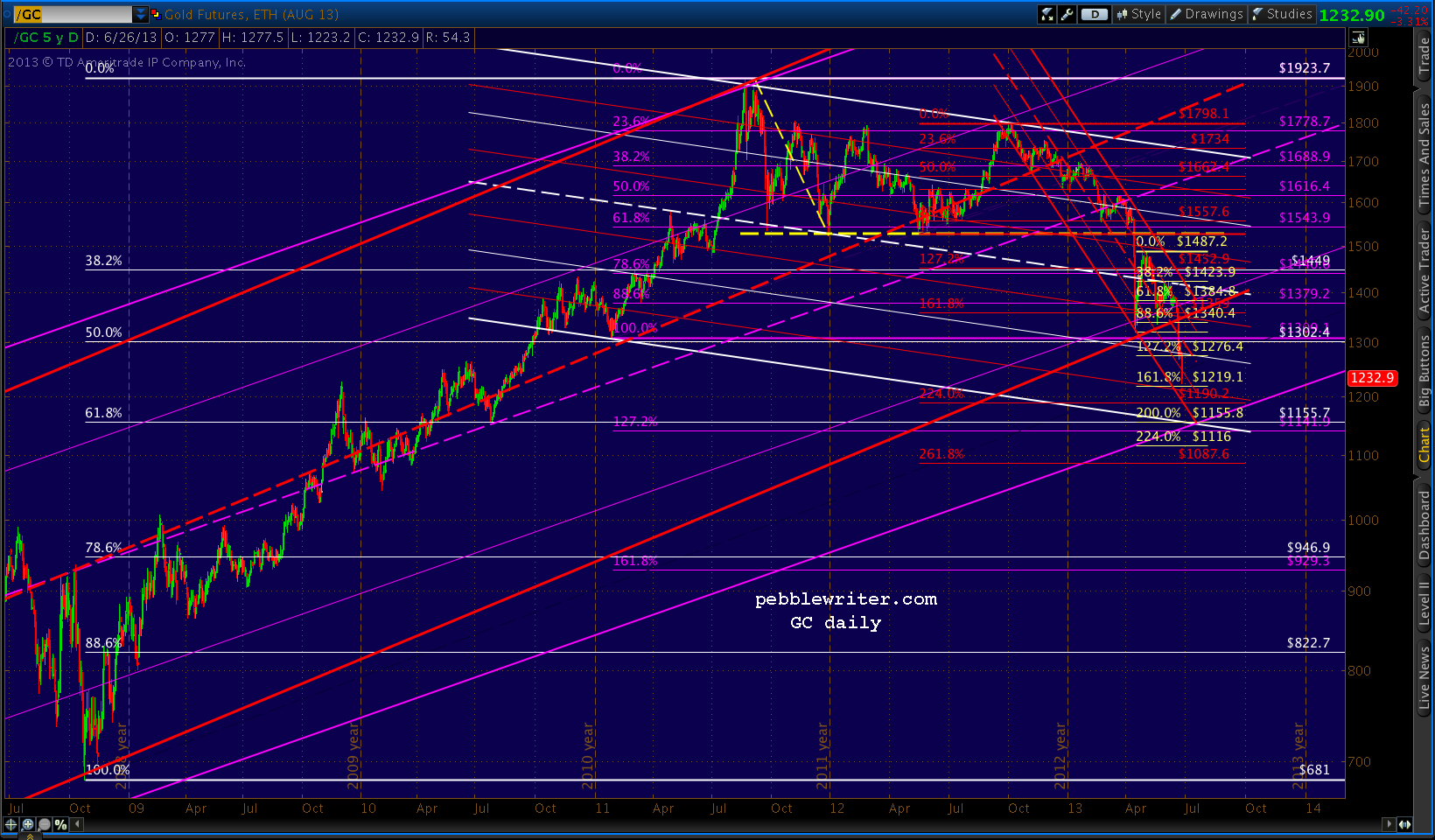
When the big red channel from 1999 broke down on Jun 20, GC plunged again.  It failed to catch a bid at the first support level, but is approaching the second one this morning: the yellow 1.618 that completes the Crab Pattern at 1219.10.


This seems like an opportune time to update the forecast, as gold's price action continues to provide valuable clues as to investors' expectations about QE, the value of the dollar and inflation.  Are the many calls for gold to fall below $1000 per ounce well-founded?

Probably not.  We should get a decent bounce beginning at or near 1219 today that could take prices as high as 1320 or so by July 5-8.  A continued rally through the red midline would mean additional gains to 1357-1385 by mid-July.

But, there's a better chance of a plunge to 1155 instead -- and it need not respect the Crab Pattern about to complete, especially if today's equity rally falters (gold certainly isn't buying the More QE! snake oil.)

Remember that 1155 is the .618 retracement (in white below) of the huge rally from 681 in 2008 to last September's 1923 all-time high. Around July 15, the bottom of the big white channel and the bottom of the red channel intersect there with the bottom of the big purple channel (it replaced the red one that failed on Jun 20.)

This is the same price target we identified in our April 15 Update on Gold.

We can speculate about what circumstances might provide for a floor.  The prevailing wisdom these days is yet another round of QE -- or at least inflation of some variety. With interest rates on the rise, that seems likely enough.  We'll stick a pin in the idea of a mid-July market calamity that necessitates Fed intervention.

...continued on pebblewriter.com...

Wednesday, April 24, 2013

Chart Patterns and You

ORIGINAL POST:  9:15 AM EST

Last night, the dollar tagged the .786 Fib retracement of its decline from Apr 4.  It subsequently sold off almost to the .618 but, so far, is hanging in a rising wedge.


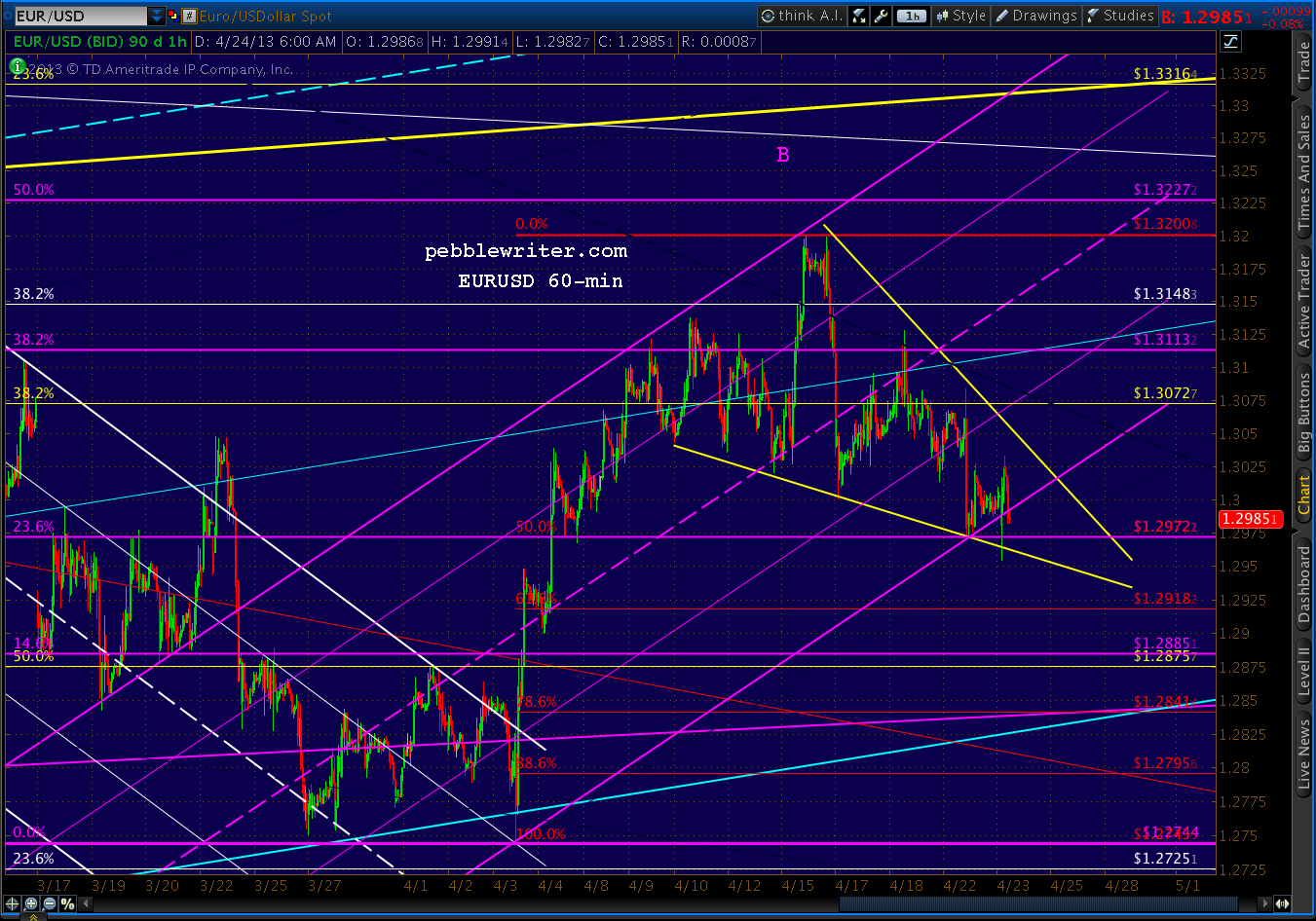
The EURUSD re-tested the .500 Fib of its rise from Apr 3, and snapped back into its falling wedge and the (purple) channel that's guided prices since then.


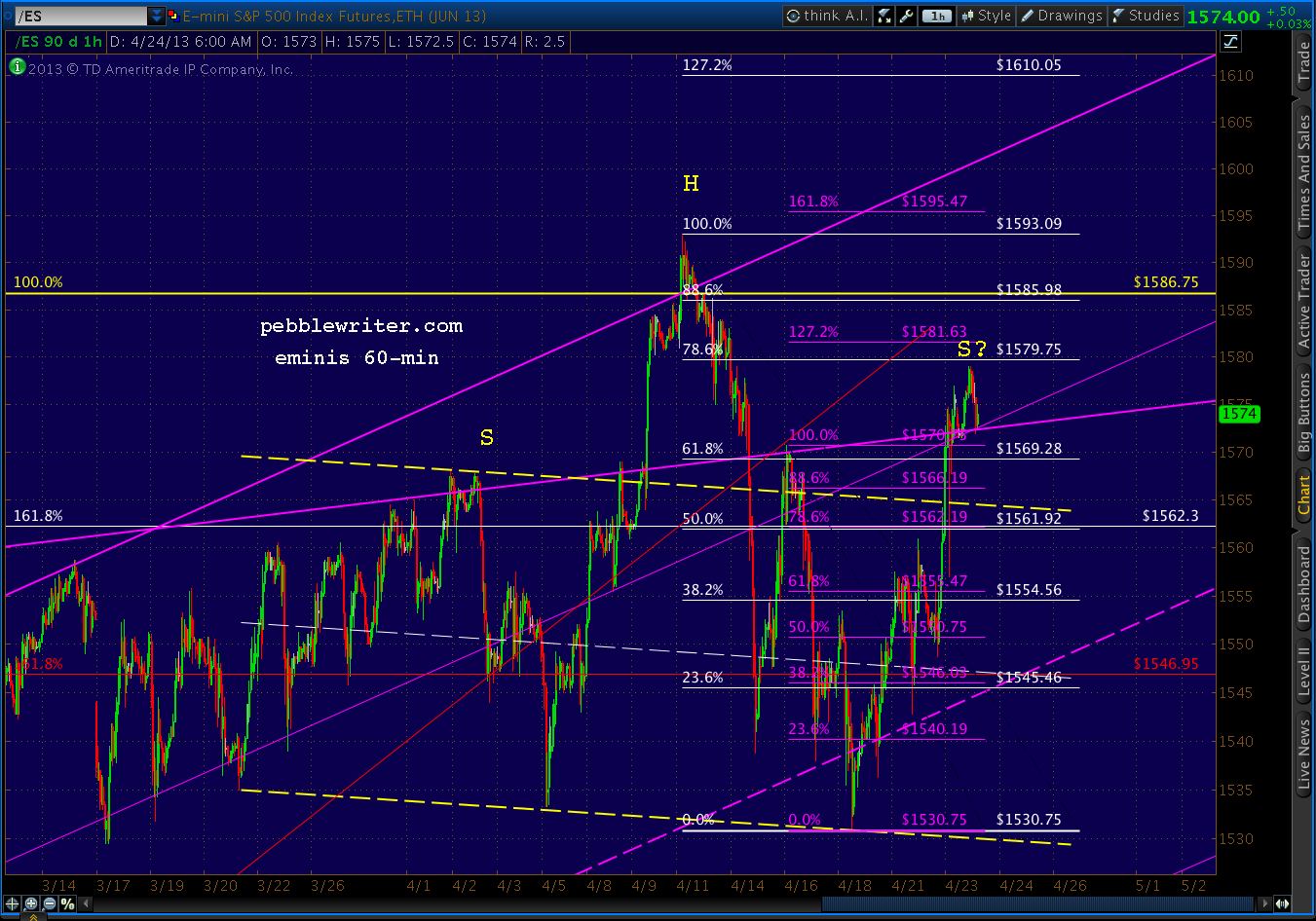
The e-minis tacked on a few points overnight -- almost reaching the .786, only to give them all back with this morning's underwhelming Durable Goods report.  The Head & Shoulders Pattern that was looking pretty good at yesterday's open is now looking a little iffy, with a right shoulder that's already 15 points higher than the left.


UPDATE:  9:45 AM

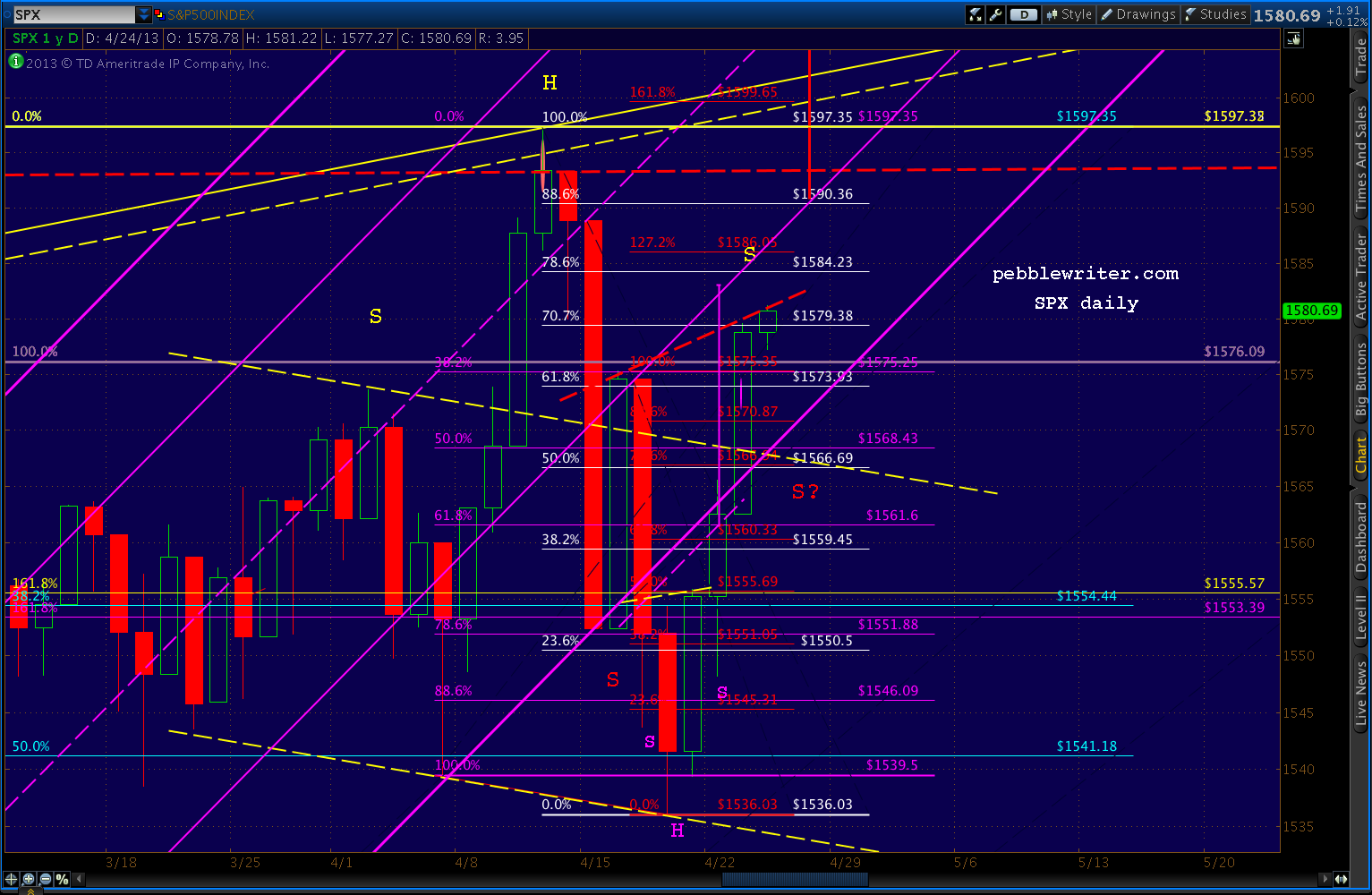
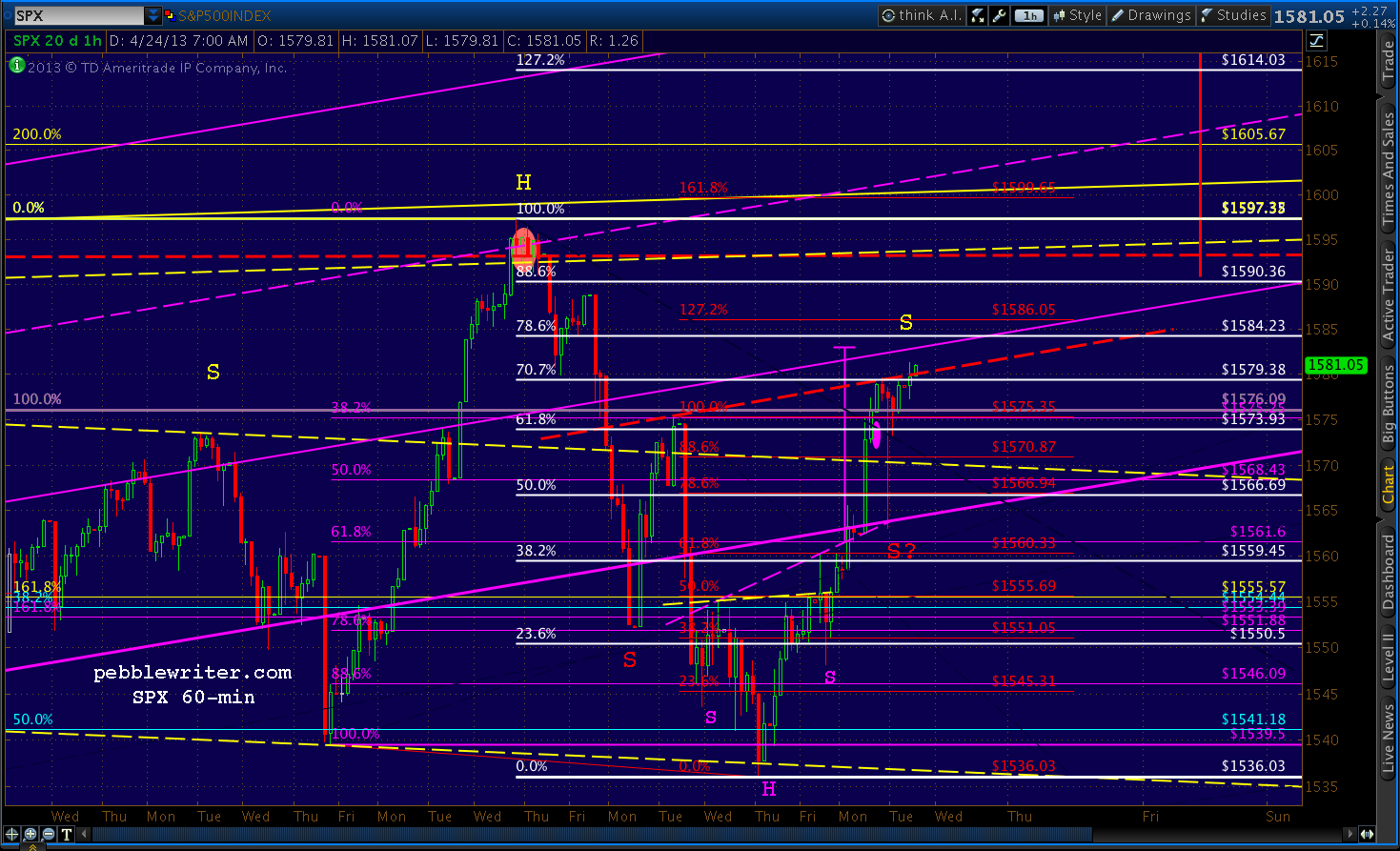
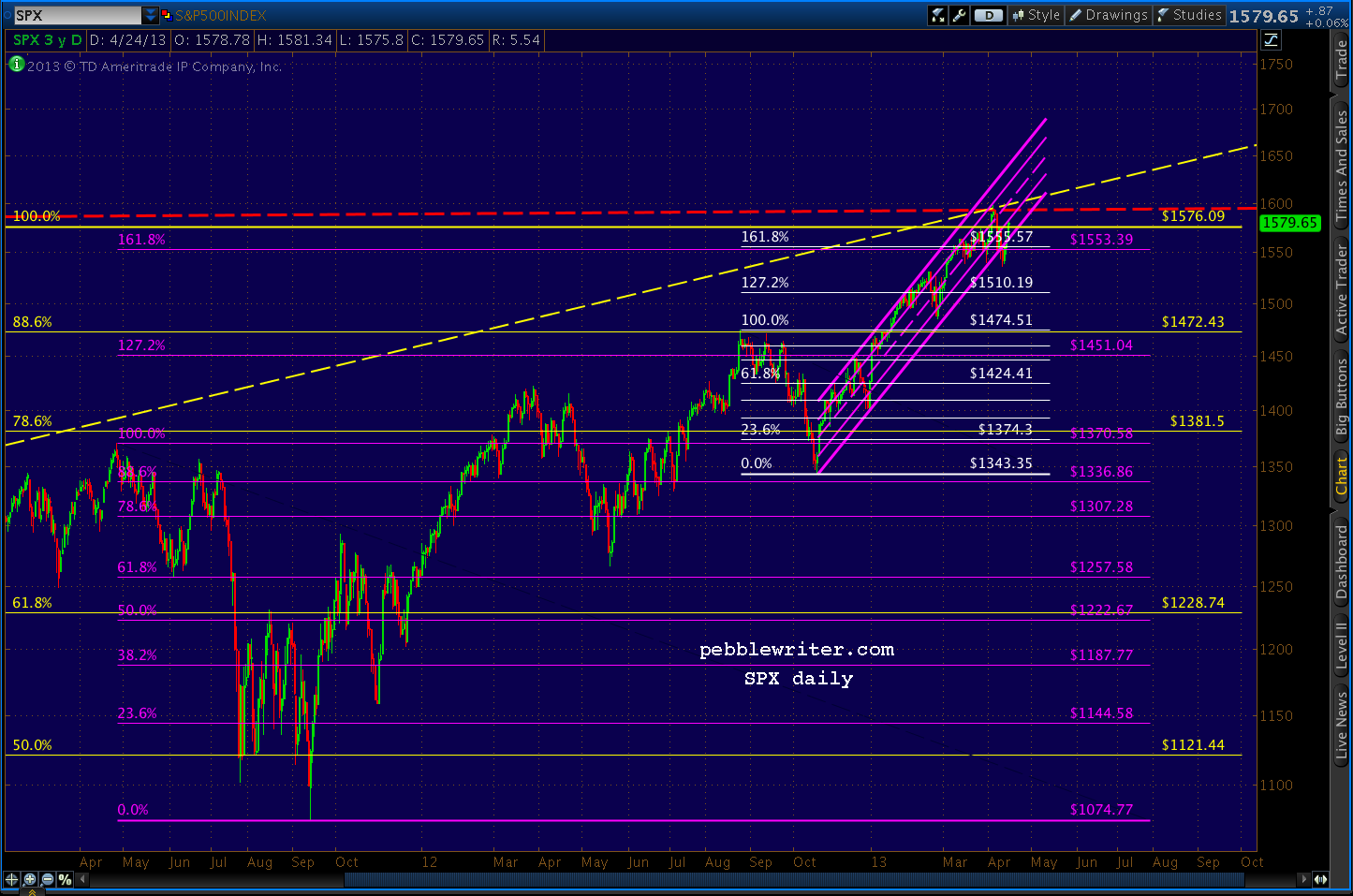
SPX continues trudging toward the .786 retracement (1584.23) of its decline from 1597 to 1536.


After plunging beneath the channel that's guided it from 1343 to 1597 on Apr 17, SPX rallied and re-joined the channel yesterday.  This was a very bullish development, as long as SPX remained in the channel all the way to the closing bell.

Despite a five minute thrill ride from 1578 to 1563 (the channel bottom) and back, SPX managed to regain and hold the 2007 high of 1576.09 into the close.

It now sits perched on the neckline of an Inverted H&S Pattern which has either completed or not, depending on whether a 5-minute plunge qualifies as a shoulder.  Short answer -- I have no clue.


Here's what we do know:
  1. Prior to Apr 17, SPX had been locked into that purple channel below since 1343 on Nov 16 -- an 18.9% gain in five months
  2. SPX barely paused when it completed two big Crab Patterns -- the 1.618 extensions of the 1370-1074 decline and the 1474-1343 decline (purple and white below)
  3. Instead, SPX exceeded the Oct 2007 high of 1576.09 (yellow)
  4. SPX reversed at 1597.35, almost precisely at a trend line drawn between the 2000 and 2007 highs
  5. SPX fell 3.8%, making a lower low, dropping out of the channel mentioned above and suggesting a H&S pattern that targets 1474 -- the Sep 2012 high (white pattern)
  6. It roared back into the channel, retracing almost 78.6% of its drop
  7. In the process, it topped the 1576.09 high and the 1553 and 1555 Fib levels and almost reaching the 1583 target of an IH&S Pattern
  8. Depending on your interpretation, it might also have completed an IH&S that targets 1621.


What Does It All Mean?

When I forecast markets, I look for lines in the sand.  I try to determine price levels that, if crossed, would signal a change in trend.  When that trend switches from bullish to bearish, I want to be short.  When it switches from bearish to bullish, I want to be long.

A channel is one such method that features boundaries rather than absolute price levels.
As long as prices remain in a rising (or falling) channel, we can expect prices to continue to rise (or fall.)  It's rather simplistic, but it usually works.  We can make educated guesses as to future price targets based on where the channels point.

Of course, even well-formed channels (multiple tags on the top and bottom and over a sufficient time period) can't go on forever.  I look for moments when prices must choose whether to remain in or leave the channel.  A tag of a top or bottom bound or midline usually create opportunities, though other lines can as well.

The Real World

Recall that we shorted SPX at the 1597 high on the 11th [see: Big Picture], riding down to the channel bottom where I went long at 1554, expecting at least a bounce.  We got one on the 16th with SPX rallying up to 1575 -- the channel .25 line.

We closed our long position, going short the following morning for the trip back to the channel bottom at 1555.  We tried another long position there, but were quickly stopped out as the channel was broken -- signalling a bearish trend change.

So, we shorted again, playing quite a few bounces down to 1540 where we eventually went long in anticipation of establishing a H&S Pattern neckline [see: Dollar Daze.]

At that point, I expected a back-test of the broken channel.  We got it, reaching 1565 on the 22nd but closing beneath the channel's lower bound.  Note that this move completed 5/6 of a H&S, but the right shoulder was underdeveloped relative to the left.

Anticipating an intra-day retracement to 1567 (the .500 Fib) or 1574 (the .618) the next day (yesterday), I stayed long -- trying without much success to anticipate the top.  Since SPX topped the .618, the next up on the chart is today's target: the .786 at 1584.23.

Going Forward

With all that as preamble, here's what I expect going forward.

...continued on pebblewriter.com...

Monday, April 15, 2013

Gold Melting Down

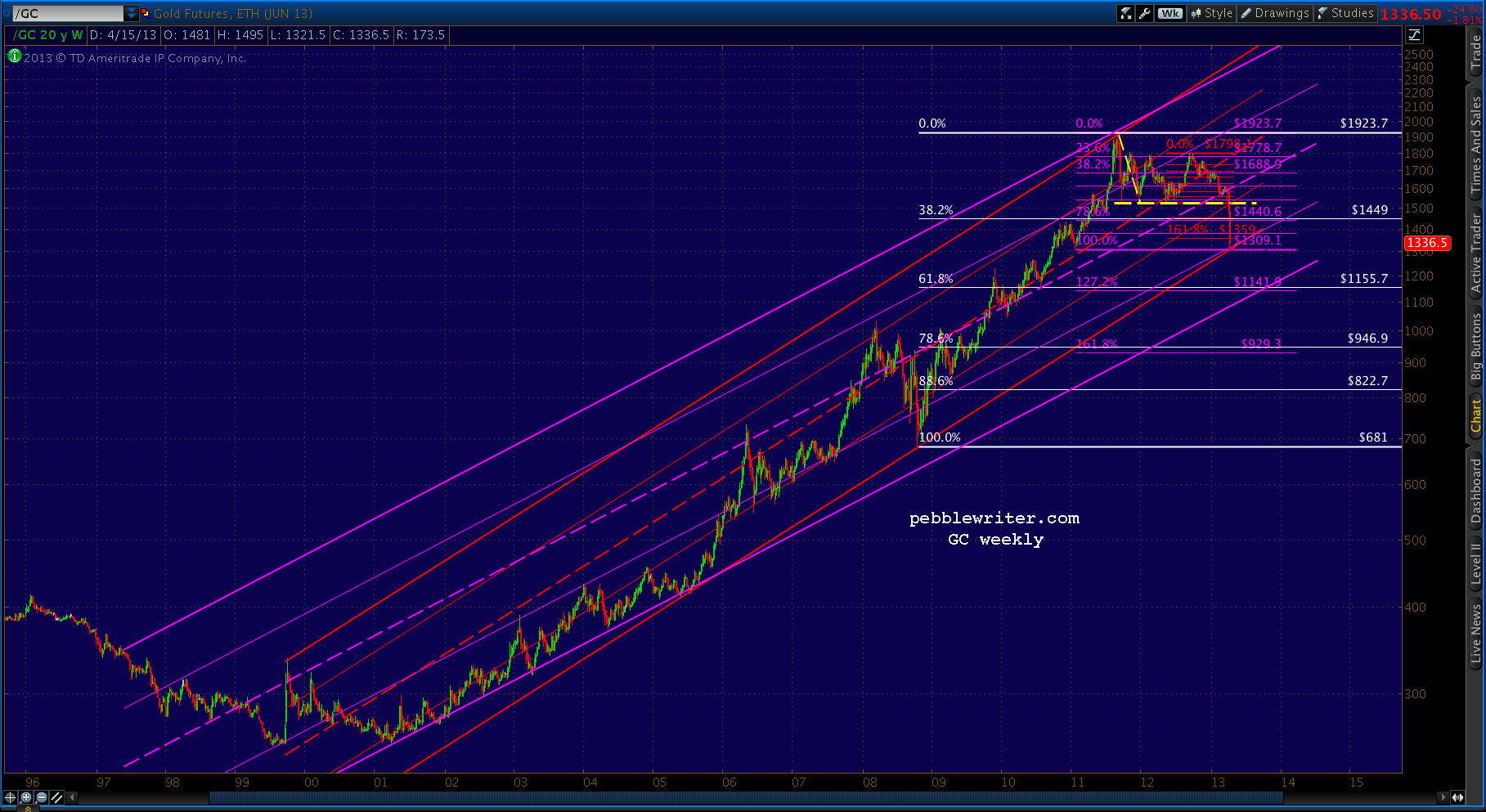
Gold continued to melt down today, shedding another $126 and continuing the plunge that started on Friday with the critical loss of the LT channel we discussed last week, the horizontal support at 1520-1535, and the psychologically important 1500 level.


Gold had a nice bounce from 1539 to 1590 after reaching the bottom of the channel and the horizontal support of several prior bounces on Apr 4.  In a dramatic demonstration of what can happen when channel support is lost, it has since shed almost $270/oz.

The red channel below represents my best shot at the new operative channel.  It supports the idea of a bounce at the Jan 2011 low of 1309 -- 3rd on our list of potential bounce spots during today's onslaught.
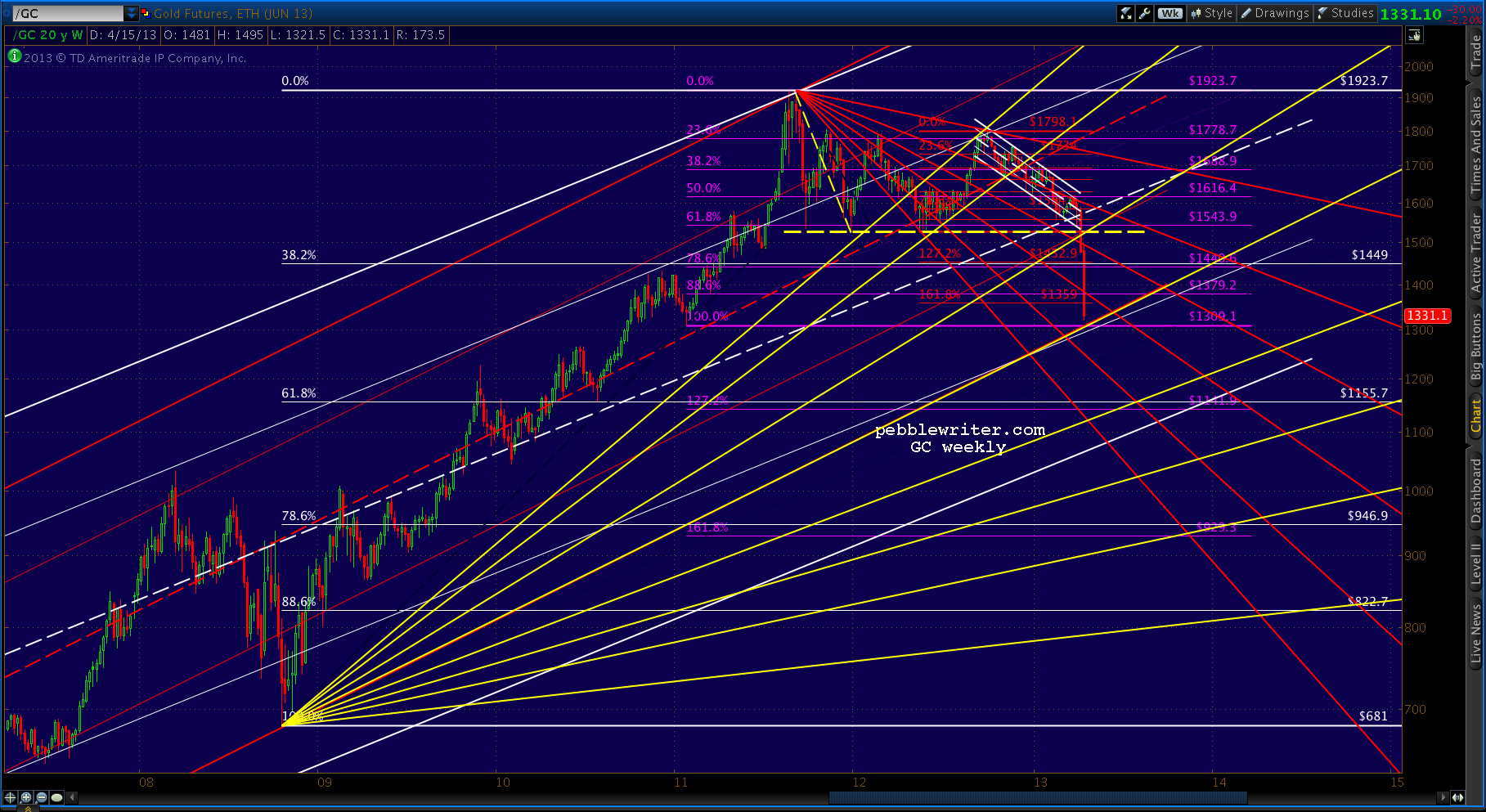
The next best available channel is well below the current one, but supports the idea of a bounce at 1379 or 1359 -- the Bat Pattern and Crab Pattern completions shown in the first chart above.  If those levels should fail to hold, the next major support levels are 1309 and 1155.
We got good bounces earlier today at the first two: the Fib retracements at 1359 and 1379  But, along came the CME with announcements of increased margins and that was the end of that.


Please note, I am not a gold bug.  I don't advocate the purchase of gold. I shy away from most assets that increase exponentially in price -- especially those backed with the kind of religious fervor as is gold.  They can drop with just as much enthusiasm.

The time may come when inflation is taking hold and it makes sense to switch everything you own into the metal... but, we're not there yet.  It's a crowded trade, and IMO, today's price action underscores the risk.

So, the following is offered in the same spirit as my picks for NCAA champion, Best Picture, and  Westminster Best in Show (the affenpinscher, really!?)

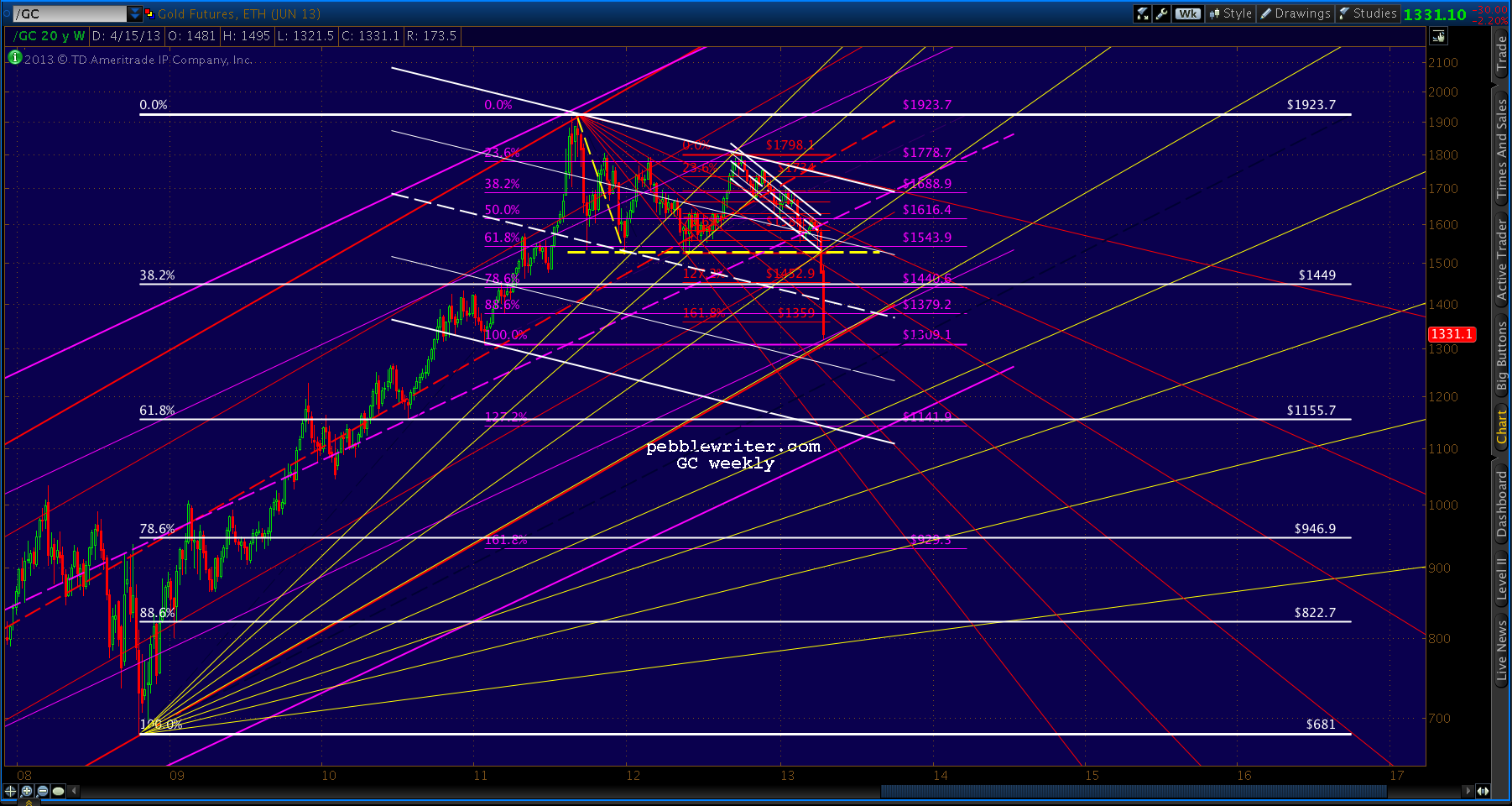
There's another channel (below, in purple) that kinda sorta supports the first, but shows the potential downside in the event that 1300 can't handle the pressure.


It's speculative, for sure.  But, I like the fact that it crosses the white .618 at a key point in time, so I'll leave it up for now.What's interesting to me is the Fibonacci Fans that can be drawn on this chart.  The ones from 681 low (yellow) have done a pretty decent job of guiding the bounces on the way down.


And, the ones from the 1923 high (red) have done well at halting several attempts at a breakout.


I could almost believe we've seen the worst of the drop, but I wonder about this potential channel...


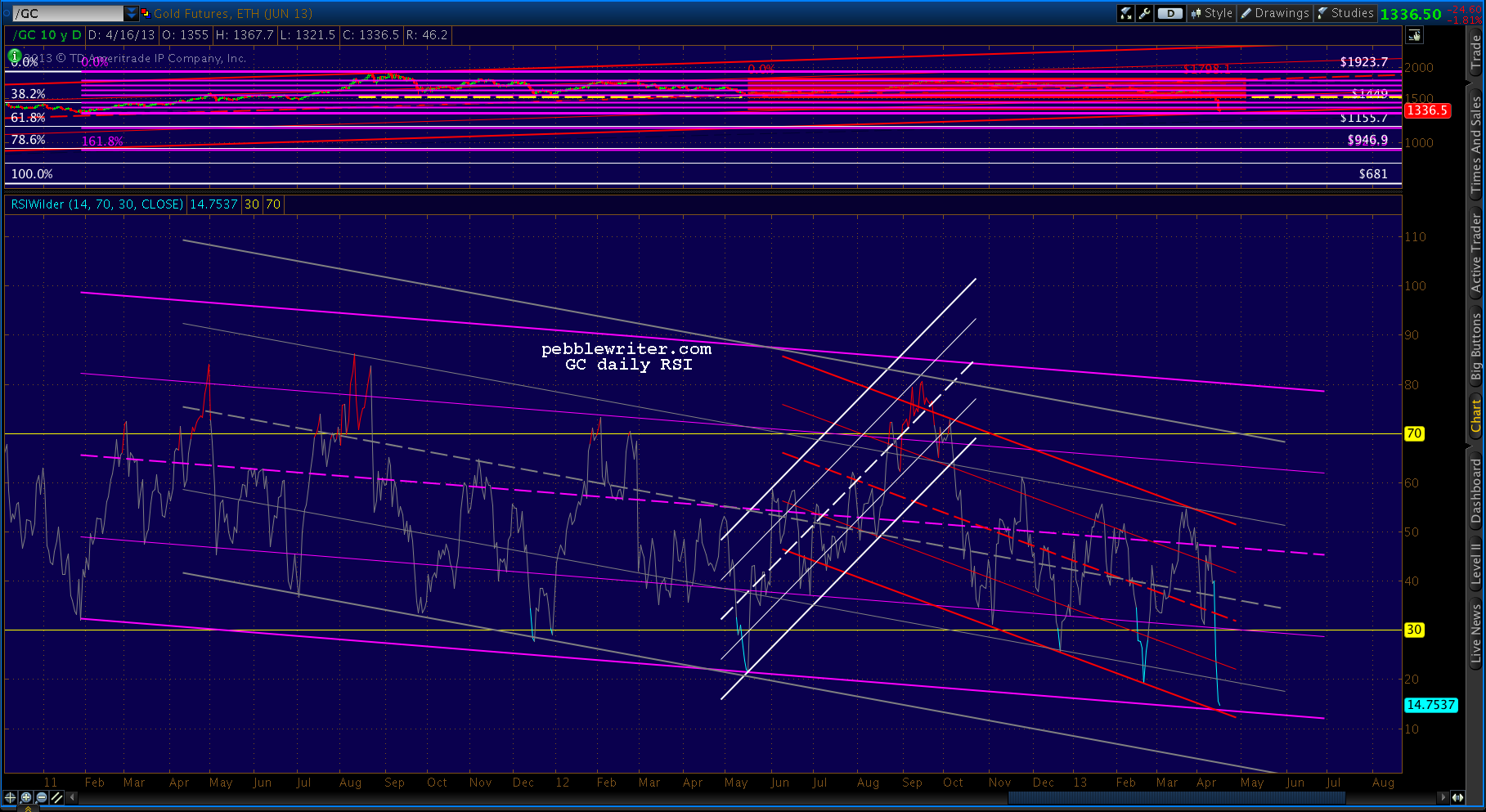
...and, the daily RSI -- which suggests at least a little more potential downside any way you slice it.  The bottom of the purple and red channels probably correlates to 1309, while the bottom of the gray channel represents something much more ominous.


So, where do we go from here?

continued on pebblewriter.com...
Friday, March 22, 2013

Anatomy of a Market Top

reposted from pebblewriter.com~

The 2000 top shows just how "messy" tops can be.  Here's the finished picture in perfect hind-sight.  It's a very crowded chart, but every single pattern had a say in how the top unfolded.

SPX had zoomed from 442 to 1478 in about 5 years, a not-too-shabby 234% gain for an annually compounded 27%.


Once SPX broke out of the falling purple channel, it had "permission" to pursue several harmonic patterns in the works.  SPX shot up 66 points in that one day -- blowing through every Fib level between .618 and 1.000.

It finally came to rest at 1458, completing a Bat Pattern at the purple .886.  But, the small white 1.272 was just above at 1477, as was the rising purple channel midline and the 1.272 from a much larger pattern seen below.

An IH&S target waited at 1497 - tantalizingly close to a nice round number of 1500.  And, the all-time high of 1478 from two months earlier beckoned.


SPX got up to 1477.33 before reacting, falling to 1466 over the next two days.  Close, but not quite.  Someone watching closely might have noticed the Flag Pattern it constructed, targeting 1562.  Someone else probably pointed out the biggest Crab Pattern target of all -- the 1.618 extension of the 13% correction from 1420 to 1233 from Jul-Oct 1999.

On Mar 21, 2000 SPX shot up through the channel midline, the cluster of Fibs around 1477 and, importantly, the 1478 high and raced up toward those higher targets.

On Mar 24, it reached 1552.87, which cleared the IH&S target at 1497, the purple 1.272 at 1519 and the last remaining Crab Pattern at 1535.  What ultimately stopped it?  The .75 line from the big purple channel dating back to Jul 1999 -- almost to the penny.

Total move: 17% and 227 points in 20 sessions.  Could it happen again?  Stay tuned.

*   *   *   *   *   *   *   * 

 Join pebblewriter.com, one of the most successful [see: results] new investment blogs on the planet, for daily in-depth market coverage, analysis and forecasts.  For more information, CLICK HERE.


Tuesday, March 5, 2013

After the Funding's Gone

~reposted from pebblewriter.com

After a scary drop in equity futures overnight, the market looks to open soft...but not exactly panicked. I remain short since 1525.34 on the 28th, but will continue to play any significant bounces that come our way.

The dollar is still looking strong, reflecting both plenty of fear and euro weakness.  Note, DX reached our intermediate target range from last month (the red .618 @ 82.22 & white 1.618 at 82.28.)


The next level of resistance is the red .786 at 83.064 where it intersects with the purple 1.618 at 83.122.  The acceleration channel that's carried prices skyward since Feb 1 intersects that nexus this week.

Also intersecting there are two channel lines -- the large white midline and the much larger yellow midline -- seen here on the weekly chart.


Daily RSI still shows plenty of upside potential, though we've also seen some negative divergence start to creep into the picture.


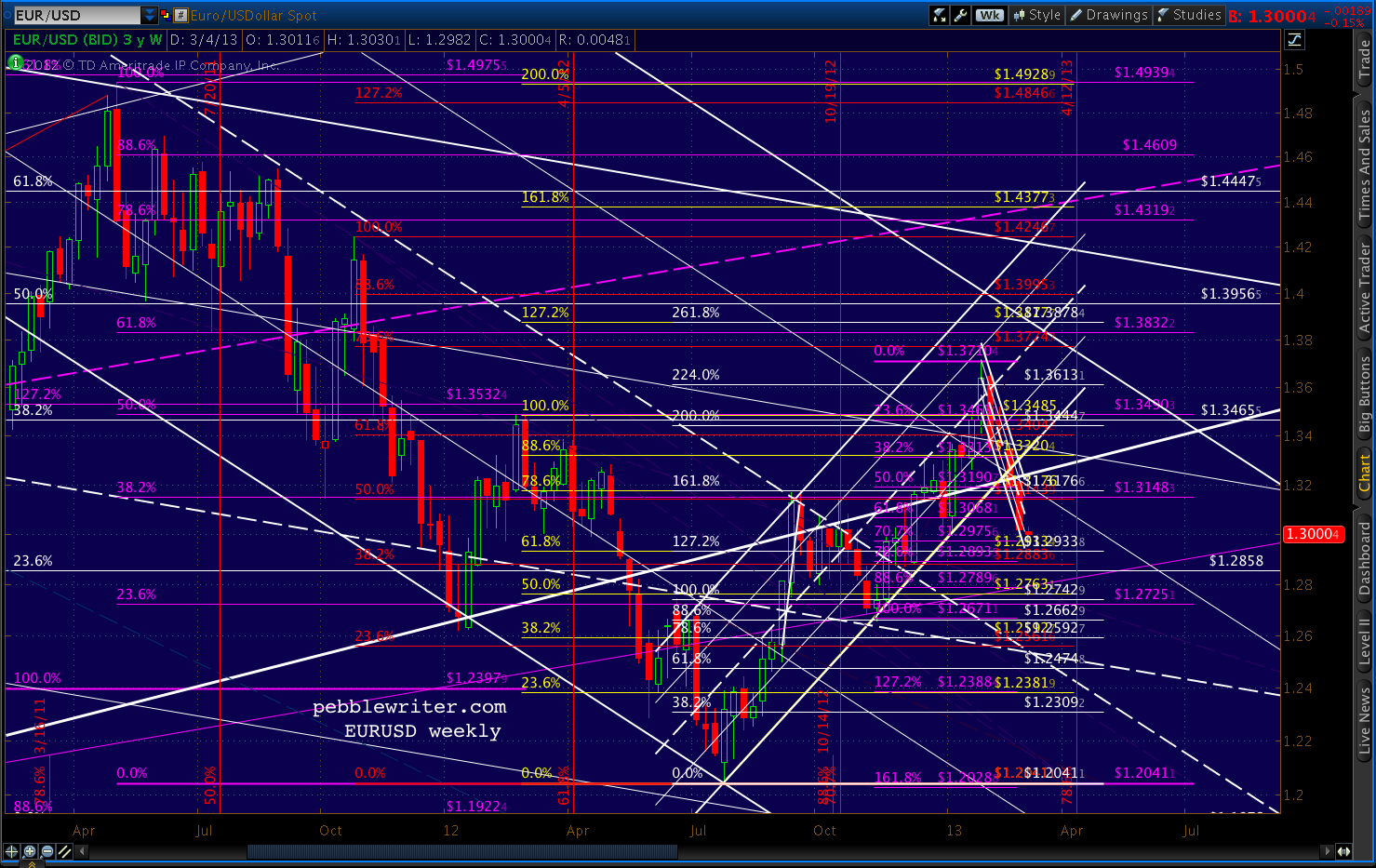
As noted back on Feb 21, the EURUSD has broken down from its rising channel (white) and has accelerated to the downside, breaking the Jan 4 1.2996 low and the psychologically important 1.30 level.


The intersection of the purple .618 and two white channels at 1.38 will have to wait (until my next visit across The Pond, no doubt.)


Losing the rising white channel hurts momentum quite a bit, but it's the drop back through the 75% line on the falling white channel that represents the bigger problem for the pair.

This channel dates all the way back to Dec 06. Reaching the top for the third time is still possible, of course, but it's that much harder now that the pair needs to retake the higher channel line and mount a fresh attack.

I've redrawn the falling white channel as red and will lower its top (for now) to reflect the brick wall it ran into.  I've also sketched in a more relaxed rising channel (light blue) that reflects potential channel support at current prices (the intersection of the falling red .75 and the rising light blue .25.)


I don't know whether the pair needs to retest the falling white midline or not.  The bottom of the new light blue channel intersects with the red .75 in mid-March.  Also there is the .25 of the very large rising purple channel, which provided a huge bounce in Jun 2010.  It's easier to see in the LT chart below.


Recall that we closed a long position and last went short at 1525.34.  From there, SPX fell nearly to our initial target (1496-1500), reaching 1501.48 Friday morning before the bounce to 1519.99.

As we discussed last week, the reversal at the red .786 could be the full extent of a corrective wave on the way lower (the B wave in an A-B-C)  that is meant to test the bottom of the white or purple channels.  But, it could also be the Point B in a Butterfly Pattern targeting 1531 or 1540.


continued on pebblewriter.com... 


Monday, February 11, 2013

Is It or Isn't It (a Recession)?

~reposted from pebblewriter.com...

ECRI's Weekly Leading Indicator (WLI) came out Friday at 130.2 -- up from 129.6 the week before.  Further, they reported that the index's annualized growth rate increased from 8.2 the previous week to 8.9% -- the highest since May 2010.  I wondered: are they retracting their Sep 2011 recession forecast?  Are things really getting better?

CAN'T WE ALL JUST GET ALONG?
There's currently an argument raging between various economists and analysts as to whether the US is still in/dipping back into a recession or is on the mend. ECRI is pretty sure we're in one, while folks like Doug Short and, of course, the mainstream media think not.

There's no question that we've seen an uptick in several economic measures. My own thesis is that most of these have been not secular, but cyclical swings.  In other words, I don't yet see evidence of a sustainable trend change, only natural swings from one side of a channel or wedge to the other.

Here's an example I posted last week. Total Confidence has traced out a pretty solid-looking channel, while the Present and Expectations indices have formed expanding wedges (and are nowhere near their upper bounds, especially given the recent downturns.)
 
Hardly a day goes by when I don't second guess myself.  Is all the "good news" just one big, well-coordinated head fake or am I missing something?  I spent much of the weekend studying ECRI's historical WLI (who says technical analysts don't live exciting lives!?) and found a lot to think about.  First, a brief primer on Harmonics.

HARMONICS

Regular readers of pebblewriter.com (heck, even the irregular ones) know all about Harmonics and that the corrections experienced in April 2010, May 2011 and Sep 2012 correspond to the important Fib levels of 61.8%, 78.6% and 88.6%.


For the uninitiated, measure the drop from SPX 1576 (Oct 2007) to 666 (Mar 2009) and multiply it by a Fibonacci 61.8% and you get 1228.74.  SPX reached 1219.80 in April 2010 (within 10 points) and promptly sold off by 17% over the next three months.

In May 2011, SPX peaked about 10 points away from the 78.6% Fib level (completing a Gartley Pattern) and plunged 21.6%.  And, in September 2012, SPX reached the 88.6% Fib level (completing a Bat Pattern) and corrected by almost 9%.

Those of us who follow Harmonics were well aware of each of these downturns well in advance [see: HERE, HERE and HERE] and profited nicely from the market's plunges.  Those who rely solely on fundamentals or [involuntary shudder] the mainstream media...not so much.

THINGS THAT MAKE YOU GO "COOL!"

While I had noticed the WLI's channel-like general decline before, I never noticed that it also complied with the rules of Harmonics.  From its all-time high of 143.73 in Jun 2007, the WLI plunged to a low of 105.40 in Mar 2009.


Like SPX, it found its footing (thanks to QE1) and started higher.  Its first big pause was in Oct 2009 at the 61.8% Fib level.  It paused again in Jan 2010 near the 70.7% Fib, and eventually reached the 78.6% level in April -- completing a Gartley Pattern as SPX had finally retraced 61.8% of its drop.

One could infer from the mismatched Fib levels that the economy -- as measured by ECRI's leading indicators -- was ahead of the market at this point. The WLI had retraced 78.6% of its drop, while SPX had only retraced 61.8%.  In any case, they both suffered from the removal of the QE drip - SPX shedding 17% and WLI 11%.

When the Fed realized their patient would flatline without more QE, they were back with QE2.  The market took off, reaching the 78.6% Fib in May 2011.  This also completed a Crab Pattern, a 161.8% extension of the amount of the Apr-Jul 2010 slide.

The WLI, however, retraced only 78.6% of its slide since its 2010 high.  In other words, the market was now officially ahead of the economy.


Following the expiration of QE2, SPX plunged 21.6% to 1074 through October 2011, while WLI gave up 8.9%.  From there, SPX climbed to 1474 primarily on Fed jawboning and promise of more QE -- which it finally delivered the day before the 1474 high.

The timing was no doubt an effort to send the SPX soaring right through the 88.6% Fib retracement of the 1576 - 666 crash.  I seriously doubt that "two points over" was what they had in mind (the market sold off anyway, correcting a respectable 8.8% to 1343.)


The WLI, in the meantime, topped out at 127.77 -- only an 88.6% retracement of its decline from its previous high in 2011.  Again, the market was outpacing the economy.

IS IT OR ISN'T IT?

The world of market prognosticators is, as always, divided.  There are those who believe the economy is improving, and the market - as a leading indicator itself - is all the proof we need.  Then, there are those who believe the market is priced well in excess of levels justified by the underlying economy -- which remains in or is dipping back into a recession.

Whether QE has "saved" the economy or not, I don't know of any respected economist or technician who doubts that it has significantly goosed (i.e. "manipulated") the markets. And, we should pay attention to the disconnect between the markets and the economy as evidenced by the SPX/WLI comparison.

The WLI just hit an important Fib level (88.6%) after demonstrating that it does, indeed, pay attention to such things.  This occurred at the same time that the S&P 500 hit several important Fib levels and is thus, by my reckoning at least, poised to correct [see: Satisfaction.]

We all know the old truism "the market isn't the economy." However, another quarter of negative GDP following the tax hikes recently enacted and spending cuts in the works would certainly remind investors that the market and economy are, indeed, joined at the hip.

I care about the economy because I have children.  The Fed's unprecedented experiment in QE will quite possibly end very badly for the country, for my children and for yours.  But, there ain't much We the People can do to influence Fed policy.  They don't answer to us or our political "leaders." So, we play the cards we're dealt.

As an investor, my goal is to capitalize on whatever the market throws at us -- regardless of how manipulated it might be, and regardless of what economists call the current business cycle. If depression or hyper-inflation come along, we'll hopefully see it coming and be well-positioned.

Are we still in or dipping back into a recession? Will the current QE4-ever result in another 2009-2011 run, or does the market's yawn last September signal the end of QE's effectiveness?  We'll find out in time.  In the meantime, we have some very good tools at our disposal that have provided excellent returns in a very difficult market.  I'll continue to call it as I see it, and appreciate having you all along for the journey.

*  *  *  *  *  *  *  *

Interested in learning more about Harmonics and Chart Patterns?  Want to learn how to apply their predictive powers to your investing?  Check out pebblewriter.com, a leading independent website dedicated to educating its members about market analysis and forecasting.  For membership information, click HERE.

Tuesday, January 29, 2013

DJIA: Any Time Now

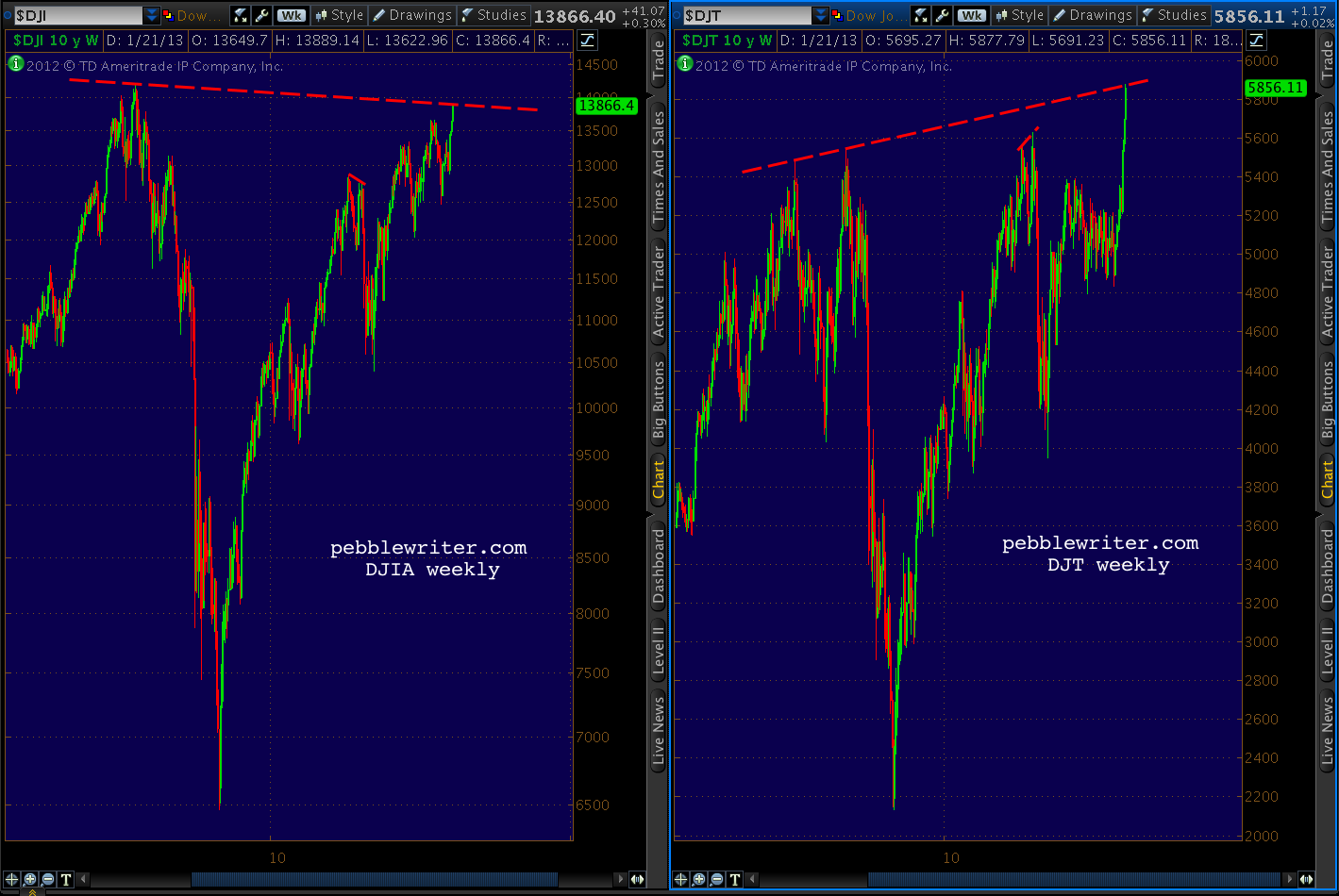
Last week, with the DJIA at 13,866, we took a look at the potential for a double-top and a Dow Theory non-confirmation with the Transports [see: The Dow - Time to Double Down.]

Critical levels included the rising wedge upper bound, not to mention a whole slew of approaching Harmonic targets.


Don't look now, but DJIA is only a few points away from tagging the upper bound of the rising wedge, the 2.24 of a Crab Pattern (in white below), and the 1.272 of a Butterfly Pattern (red.)

The double-top up at 14,198 and some larger Harmonic patterns (14,145-14,201) are still a possibility, but this balloon looks ready to pop.


Pebblewriter.com combines Harmonic Patterns with traditional chart patterns and technical analysis.  For more on our process and results, visit pebblewriter.com.


Friday, January 25, 2013

The Dow: Time to Double Down?

Many are watching the Dow Transports' recent all-time highs, wondering if Dow Theory suggests new highs for the DJIA as well.

Without wading into the debate over which interpretation of the theory holds water and which are all wet, I think it's important to recognize that the DJIA is one of those indices not making new all-time highs lately.

Should the Industrials not break above 14,198.10, this would be considered a Dow Theory non-confirmation, at least on a larger scale.  The last time this happened was in July of 2011, when the Transports made a new high of 5627.85 and the DJIA failed to best its May 2 12,876 high.

We can argue about cause and effect, but there's no argument about what happened next.


Eighteen months later, the DJT has again broken out to new all-time highs.  DJIA has not.  Here's the current visual, which shows the current degree of divergence is much larger than back then.


The Industrials, in fact, are a great candidate for a double-top.


Drilling down, we can see DJIA has nearly completed a Crab Pattern at the Fibonacci 161.8% extension (14,201.84) of the July-October 2011 crash (the white pattern.)


It intersects nearly perfectly with the previous 2007 high of 14,198.10 at the very point where the purple channel top and white 25% channel line also intersect.  But, it need not even reach that level to be considered a double top (within 1%.)

And, only a few points away we find a Butterfly Pattern target (small red pattern) at 13,985.65 and a Crab Pattern target (in white) of 13,963.50.


The last leg up in the move since October 2011 has been 1424 points -- roughly 87% of the leg 3 rally between June and September of 2012.  A Fibonacci 88.6% of the leg 3 rally would register at 13,912 -- well within the margin of error for any of the harmonic patterns mentioned above, and only 16 points above today's high.


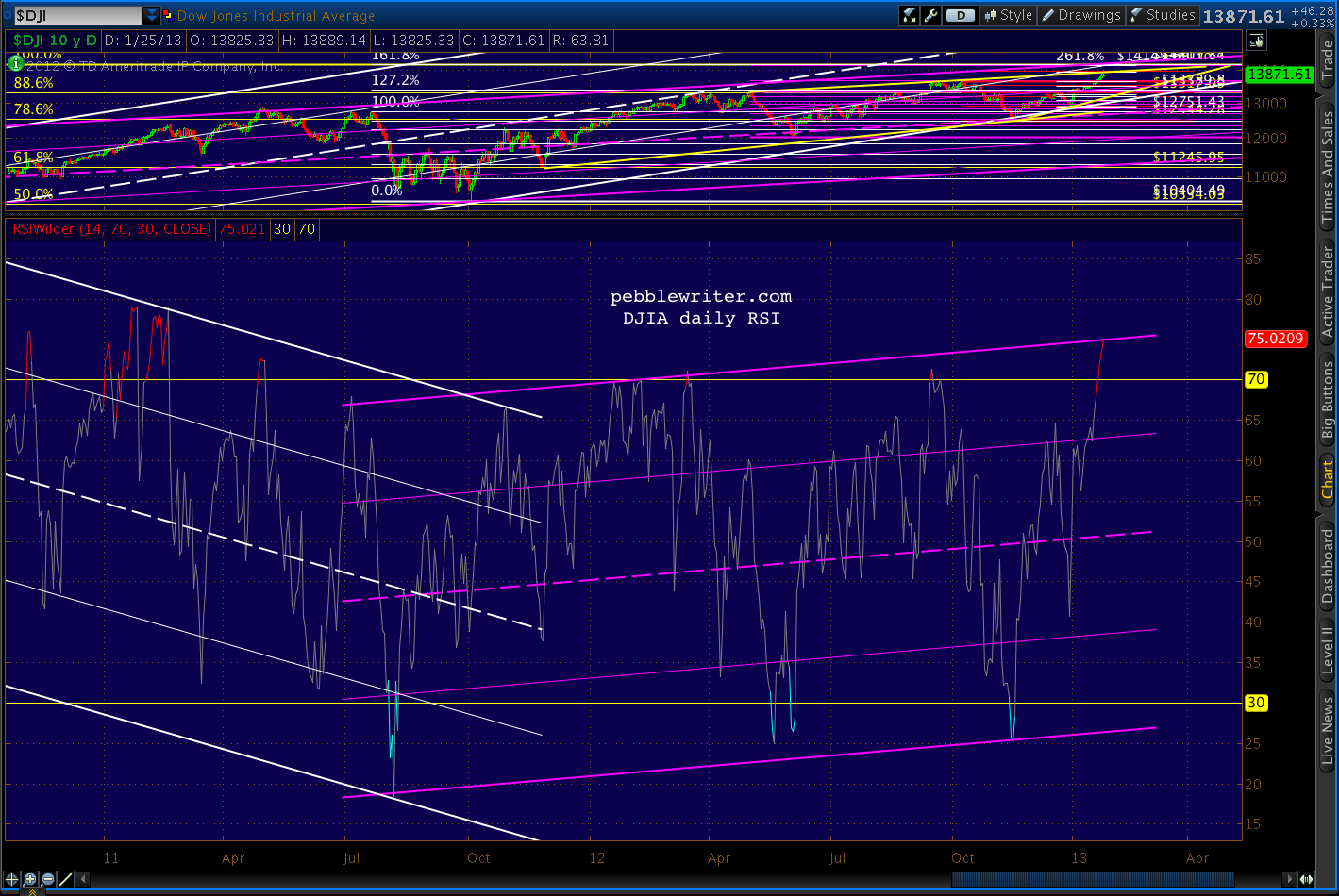
And, for those who, like me, love to channel stuff, the DJIA's daily RSI has its own bearish tale to tell.


Could DJIA blow through 14,200 confirm the Transports' all-time high and spoil the bears' party?  Of course.  There are still plenty of earnings reports to sift through, including AMZN, CAT, FB, YHOO, IP, PFE and F in the next few days.  We could get great Durable Goods numbers Monday, Case-Shiller Home Price Index on Tuesday, or a bullish FOMC outcome on Wednesday.

But, anyone counting on new all-time highs should remember July 2011 and consider protecting their downside.

Thursday, January 24, 2013

Bonds: The Big Picture

~reposted from pebblewriter.com

First, an important caveat:  I'm not a bond guy.  Never have been, never will be -- at least with long bonds under 8%. To me, the idea of sinking even one dollar into a security (which should be downgraded, mind you) that guarantees less than 2% for 10 years borders on insanity.

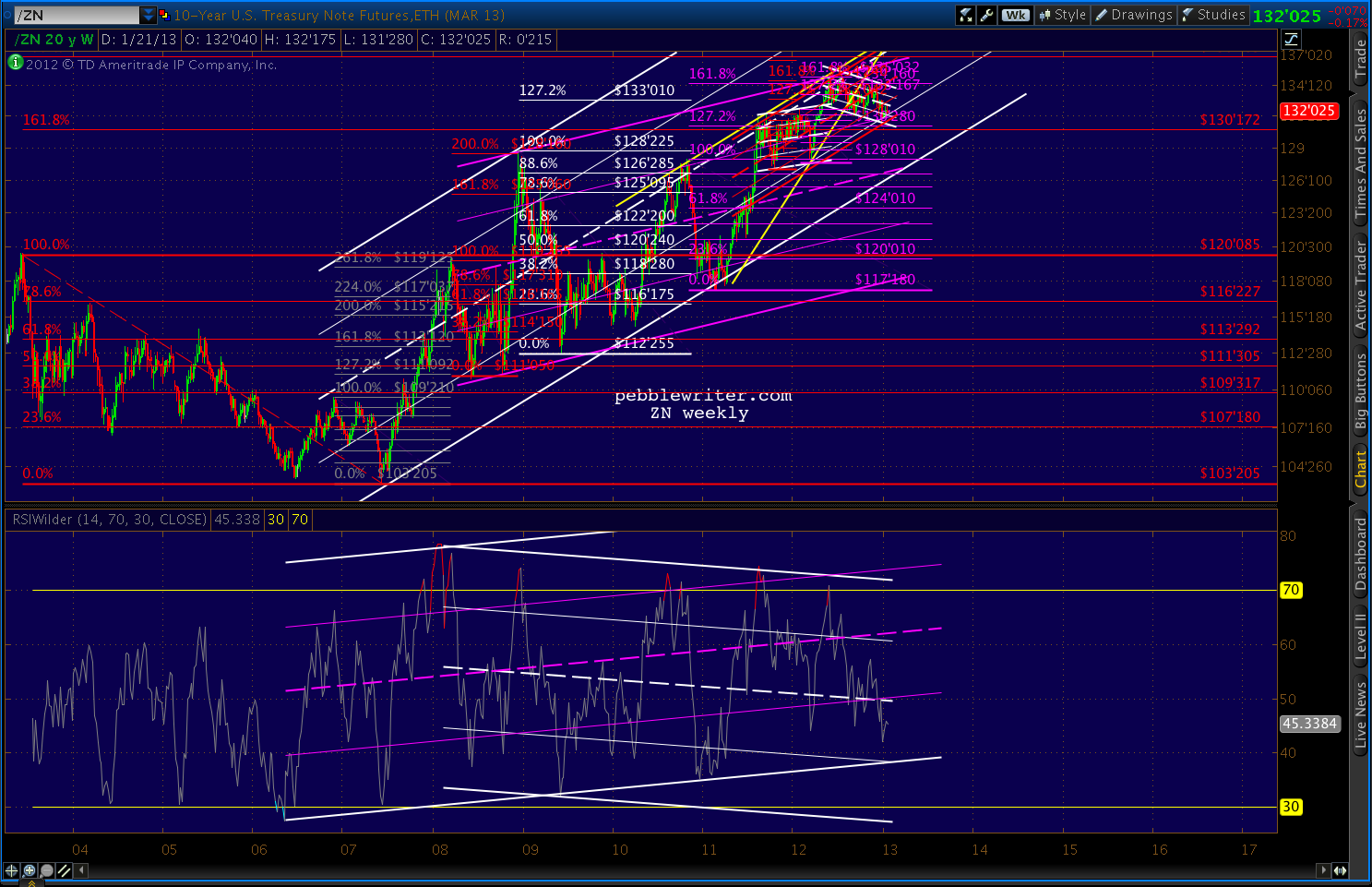
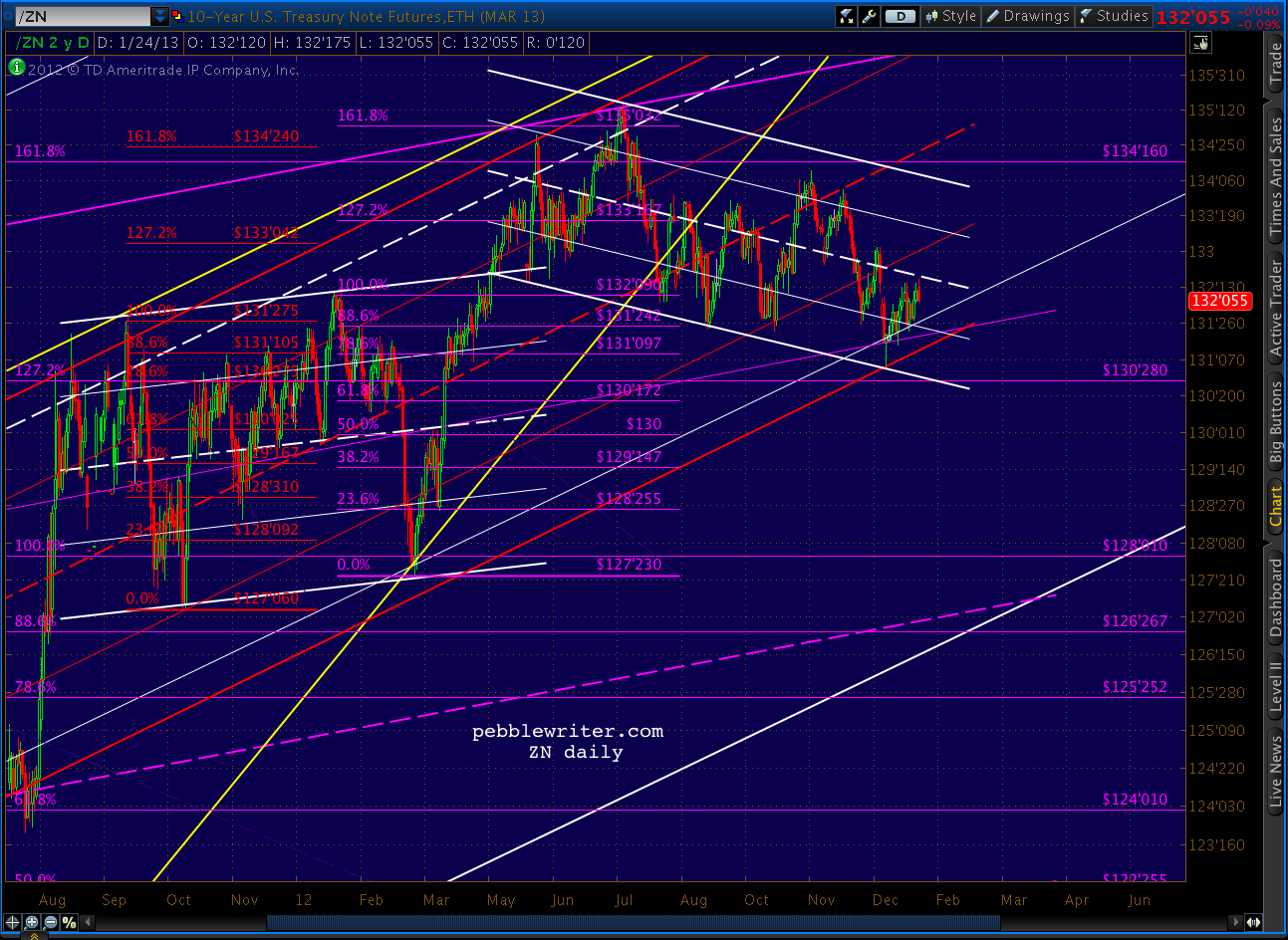
But, different strokes and all that.  Plus, bonds can be a good window on equities and currencies, so I don't mind charting them once in a while.  The 10-yr has obviously been on a tear for several years.  It's settled back from the 2008-09 spike into the bottom half of a channel that dates back to 2005 (white.)


The big question is whether the white channel is still in charge, or the less aggressively sloped purple one has taken over.  Making things interesting, there's a pretty well-formed rising wedge that broke down in August.

But, the RW is slightly suspect because the July 25 high was slightly exceeded on Nov 16 and Dec 6, meaning there are two higher highs and a higher low in place since the August break (though both highs came on negative divergence relative to the July high.)

Harmonics have performed pretty well with the 10-yr note.  The chart below shows a big Crab (grey), followed by another Crab (red), a Bat (white) and another Crab (purple.)  Each previous Crab Pattern completion has been followed by a significant retreat, so we might suspect one here with the purple pattern completion.


The only potential hitch is whether the white pattern is still in play.  Bats can and do go on to form Crabs, and the white 1.618 is way up at 138'170 -- a 4.5% increase from current levels.


There is a significant amount of negative divergence on the daily and weekly channels, so I suspect not.  But, obviously, a strong equities sell-off would turn that assumption on its head.

A return to the top of the red channel would take daily RSI to the purple midline.  On negative divergence, that could easily line up with the white 1.618.


The close-up shows a potential channel since the most recent Crab Pattern reversal and the impact of the white 25% channel line.  The easiest call is for a bounce off this line as well as the small channel bottom.  If that occurs, the 138'170 level is in the cards.


Otherwise, the bottom of the white channel and the middle of the purple channel intersect at the 126-127 area (the purple .886 is 126'267 and the white .886 is 126'285) around the middle of March.

Tuesday, January 15, 2013

AAPL: Flirting with Disaster

Not since the summer of 1666, as young Zack Newton sat pondering gravity, has so much attention been paid to a falling apple.

Should we care about AAPL's deteriorating powers of levitation?  The $200/share drop since its September highs, especially on the heels of a new dividend and share buyback program, has been unnerving.  But, if you invest based on fundamentals, it's a solid company selling at 11 times earnings and a 62% 5-year CAGR -- which happens to be on sale.

If you pay attention to chart patterns, however, AAPL is flirting with disaster.  It's a mere point or two from completing a Head & Shoulders pattern that targets the low 300's. [To read about how H&S patterns work, click HERE.]


Even if you don't give a darn about chart patterns, know that many other investors do.  The four tags of the white trend line (the neckline) in the past month are ample proof.  So are the many previously completed patterns that weighed on AAPL.

In January 2008, AAPL completed a H&S pattern that saw share prices drop from 200 to 115 in a few short weeks.


Buyers at 115 were rewarded with a rebound to 190, then punished by a plunge to 78 as the rebound completed a right shoulder in a much larger H&S pattern.


Not every pattern plays out, of course.  Consider the pattern below from 1993-1994 -- a well-formed pattern that targeted much lower prices.


Instead of a big drop off, AAPL found channel support before much damage was done.  Prices rebounded to new highs where they formed a new pattern (in white) which did play out.


Like any other chart pattern, H&S patterns don't occur in a vacuum.  Channels and harmonics often influence the ultimate outcome.

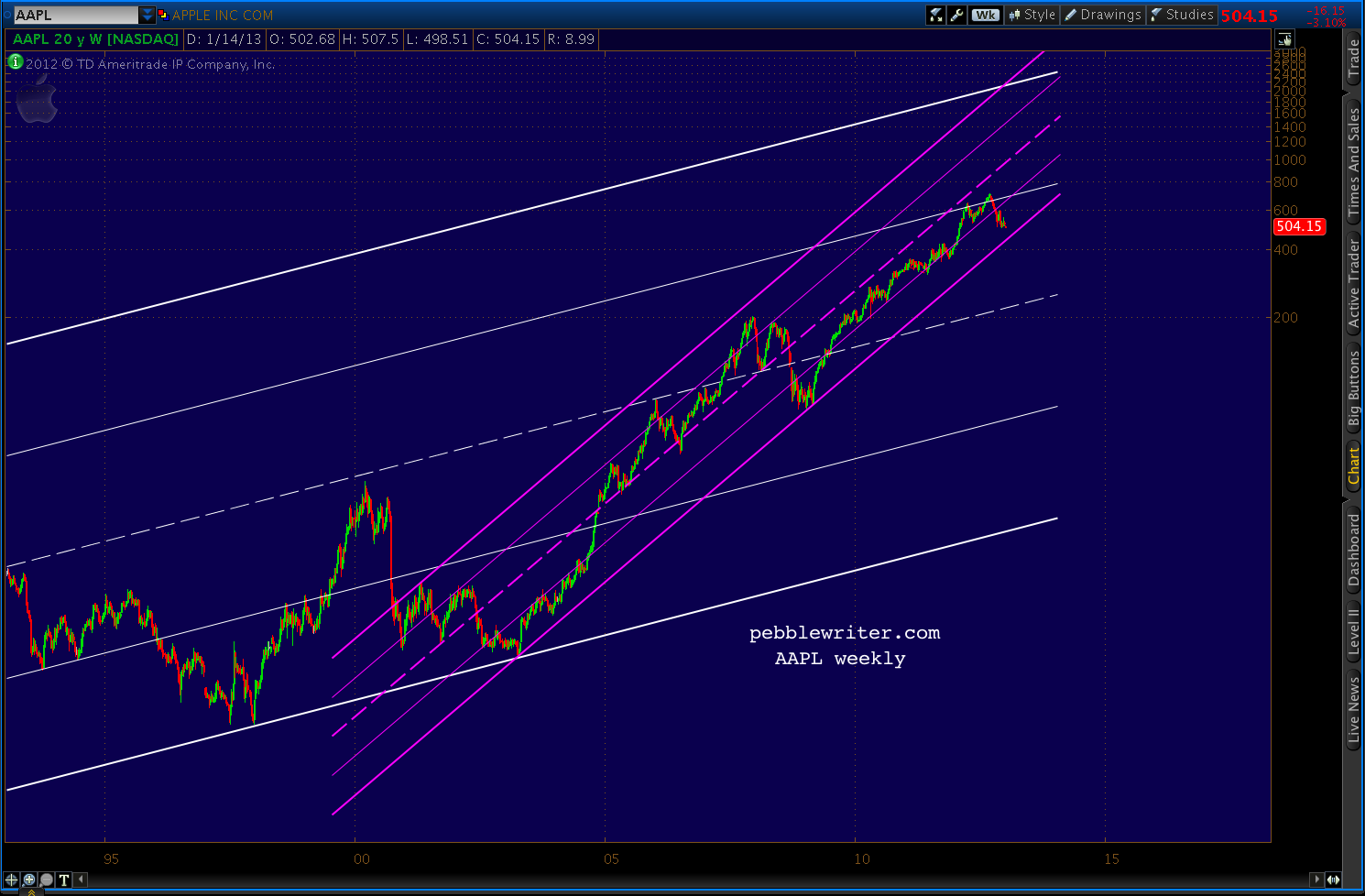
The channel that saved the day in 1995 is still with us, though it most recently offered resistance to higher prices instead of a floor.  It's the white channel in the chart below.

The much smaller, steeply rising purple channel, on the other hand, has kept prices rising -- putting AAPL back on track after two significant sell-offs.  It's currently around 445 -- within a few points of the Crab Pattern 1.618 extension of the failed mid-November rally.


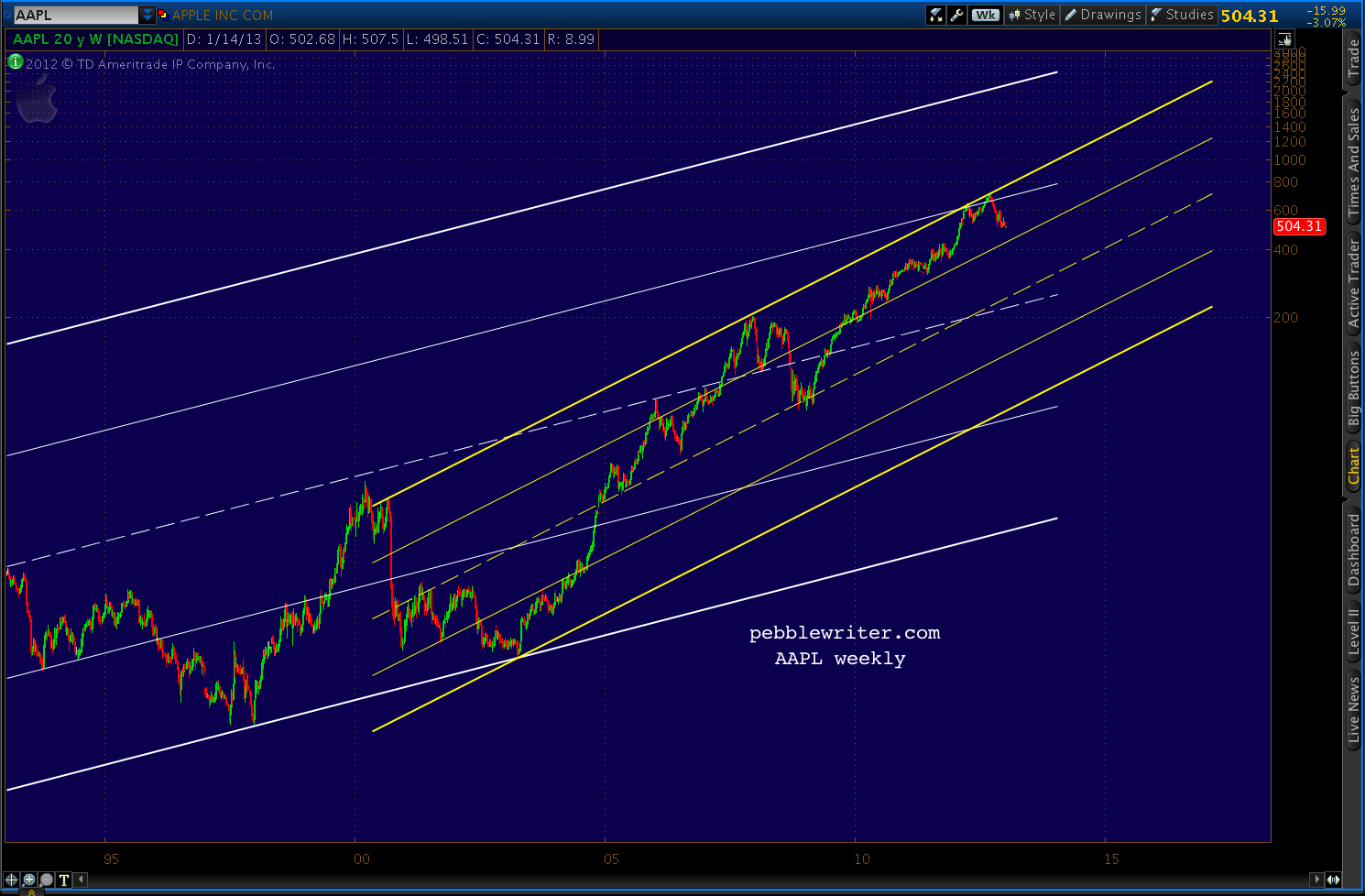
If the current H&S pattern plays out and AAPL drops below the purple channel support, there's another, less bullish channel that could come into play -- seen in yellow below.


The next lower channel line is in the vicinity of the purple line referenced above: 430 or so.  But, if gravity takes hold, mid-line support doesn't show up until around 300.  Ouch.


There are a dozen or more other patterns that could easily influence AAPL's future. There are also many fundamental events that could strengthen the price.

The company's current share buyback scheme, for instance, is only $10 billion -- about the average daily volume at $500/share.  But, with $120 billion in cash on the books and virtually no debt, the company could easily expand it to a more meaningful level.

If this most widely held stock were to crash, could the rest of the market be far behind?  I think there's little question it would. Such an outcome would spell disaster for the bullish story line that TPTB have been working so diligently to construct.

Might they join company insiders in supporting the stock here at 500?  It would be a lot cheaper than another round of QE and, in the end, probably more effective.

Stay tuned.

*  *  *  *  *  *  *  *

reprinted from pebblewriter.com